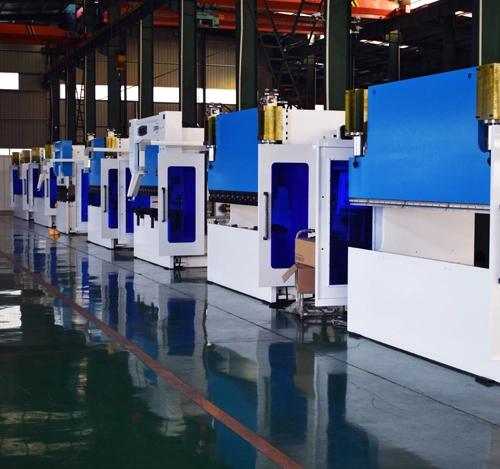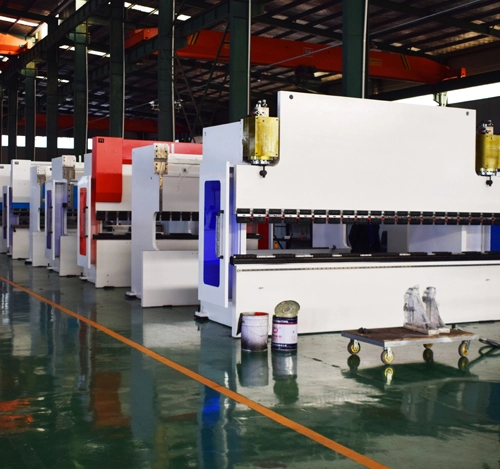
In the realm of modern metal fabrication, the term "precision" has shifted from a goal to a baseline requirement. As manufacturers move away from traditional torsion bar systems, Electro-Hydraulic Servo Press Brakes have emerged as the gold standard. But what is the actual science behind this technology, and how does it redefine the bending process?
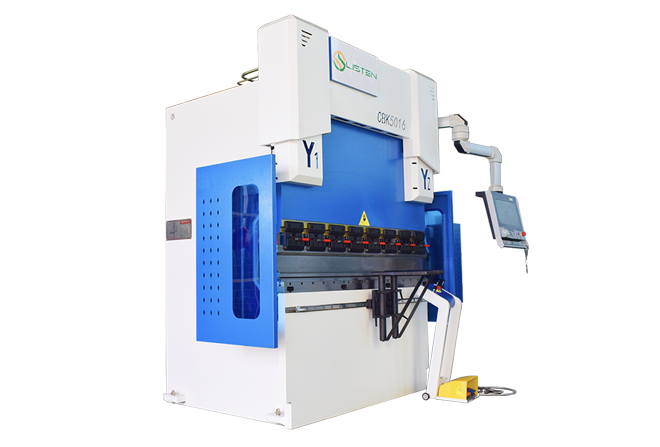
Unlike conventional machines that rely on a mechanical torsion bar for synchronization, an electro-hydraulic servo press brake utilizes a sophisticated closed-loop system.
Dual Servo Control: The machine features independent hydraulic cylinders on both sides (Y1 and Y2 axes).
Real-Time Feedback: High-precision linear encoders monitor the position of each cylinder in real-time.
Proportional Valve Correction: The CNC controller (such as Cybelec Visitouch) receives this data and adjusts the proportional valves instantly to ensure both sides are perfectly synchronized, even with off-center loading.
The "science" of a perfect bend lies in the compensation for machine deflection. Electro-hydraulic machines often include an automatic Hydraulic or Mechanical Crowning system. This counteracts the natural "bowing" of the worktable, ensuring a consistent angle across the entire length of the sheet metal.
Modern precision requires more than just up-and-down movement. A 6-axis CNC press brake allows for complex back-gauge movements (X1, X2, R1, R2, Z1, Z2), enabling the production of intricate geometries in a single setup. This significantly reduces the need for manual repositioning and improves safety.
By using hybrid servo control, these machines only consume significant power during the bending stroke. During the standby or return phases, energy consumption is drastically reduced, leading to a more sustainable and cost-effective sheet metal machine solution.
Feature | Torsion Bar (NC) | Electro-Hydraulic (CNC) |
Synchronization | Mechanical Torsion Bar | Electro-Hydraulic Servo (Y1, Y2) |
Error Correction | Manual adjustment | Automatic closed-loop feedback |
Off-center Loading | Risk of machine damage | Handled automatically by valves |
Safety Integration | Basic | Advanced (e.g., MSD Laser Safety) |
For manufacturing plants looking to transition from manual to automated bending, understanding the ROI is crucial. While the initial investment in a servo-driven system is higher, the reduction in scrap rates and setup times often leads to a faster payback period. You can explore our detailed ROI guide for workshops to calculate your potential savings.
Furthermore, precision isn't just about the machine—it's about the components. Ensuring your back gauge modifications are up to date and your tooling is properly aligned is essential for maintaining the "science of precision."
Electro-hydraulic servo press brakes represent the intersection of hydraulic power and digital intelligence. By providing unparalleled control over every micron of movement, they allow manufacturers to push the boundaries of what is possible in sheet metal design.
A closed-loop system means the machine constantly "checks its own work." The linear encoders tell the CNC controller exactly where the ram is, and the controller makes micro-adjustments to the valves. This eliminates errors caused by temperature changes or material variations.
A 6-axis back-gauge improves positional precision for complex parts. While a 3-axis machine can bend a simple box, a 6-axis system can handle tapered bends and multi-step sequences without manual intervention, ensuring every part is identical.
Advanced controllers like Cybelec offer 3D visualization and offline programming. This reduces the "trial and error" phase on the shop floor, effectively increasing your machine's uptime and precision.