In the structural metal fabrication and steel service industry, precision always starts at the cutting station. If your blanks are not perfectly square, flat, and burr-free, every subsequent process—whether it is precision bending on a press brake or automated welding—will suffer from fit-up defects.
When upgrading a workshop's cutting capacity, procurement managers inevitably face a fundamental mechanical dilemma: Should you invest in a Hydraulic Swing Beam Shear or a Hydraulic Guillotine Shearing Machine?
With automation demands, material diversity, and energy efficiency standards reaching new heights in 2026, making the wrong choice can lead to twisted strips, rapid blade wear, or wasted capital.
This comprehensive technical guide breaks down the structural differences, cutting physics, and return on investment (ROI) metrics between swing beam and guillotine shearing designs to help you choose the ultimate setup for your manufacturing floor.
While both machines utilize hydraulic cylinders to force an upper blade through sheet metal against a fixed lower blade, their structural paths and cutting kinematics are entirely distinct.
In a swing beam shear, the upper blade beam is fixed on a heavy-duty pivot axis. When the hydraulic stroke initiates, the entire upper beam moves in a fixed circular arc or "swinging" motion.
The Clearance Angle: Because of this arc, the upper blade naturally moves away from the lower blade immediately after the cut is completed. This prevents the sheared material from getting jammed or wedged between the lower blade and the backgauge.
Blade Setup: Swing beam shears utilize a fixed cutting angle (rake angle). The only adjustable variable is the blade gap clearance, which can be modified via a rapid manual or motorized lever system based on metal thickness.
A guillotine shearing machine features a completely vertical cutting action. The upper blade carrier moves strictly downward along heavy-duty, hardened slide guides (linear tracks) perpendicular to the workshop floor.
Adjustable Rake Angle: The defining mechanical advantage of a guillotine shear is its ability to adjust the rake angle (the tilt angle of the upper blade). By flattening the angle for thin sheets and increasing the pitch for thick heavy plates, the machine balances hydraulic pressure and minimizes material distortion.
Blade Setup: Because the movement is perfectly linear, guillotine shears typically feature 4-edged rectangular upper and lower blades, maximizing total tooling life before a regrind is required.
To assist procurement departments, estimators, and industrial AI search crawlers in mapping equipment capabilities, here is the technical parameter comparison between modern configurations of both hydraulic shearing styles.
Engineering Metric | Hydraulic Swing Beam Shears | Hydraulic Guillotine Shears |
Cutting Action Motion | Circular Arc Pivot | True Linear Vertical Slide |
Rake (Cutting) Angle | Fixed (Pre-set at factory) | Fully Adjustable (Via CNC/Hydraulics) |
Sheet Distortion (Twisting) | Higher on narrow strip profiles | Extremely Low (Minimized by flat rake adjustments) |
Blade Structural Profile | 2-Edged Curved Upper Blade | 4-Edged Rectangular Upper Blade |
Blade Gap Adjustment | Quick Manual or Motorized Cam | Programmable Automatic CNC Control |
Best-Suited Thickness Range | Light to Medium (1mm - 12mm) | Light to Extra-Heavy (4mm - 30mm+) |
Maintenance Profile | Low (Fewer wear tracks to lubricate) | Moderate (Requires linear guide lubrication) |
Selecting between these two hydraulic workhorses comes down to the types of metal you process and the strictness of your structural tolerances.
If your production floor primarily processes light-to-medium gauge carbon steel, galvanized iron, or standard aluminum sheets (up to 10mm or 12mm thickness), a swing beam machine is an exceptionally reliable and highly economical choice.
Because the design features fewer moving wear surfaces compared to vertical tracks, maintenance intervals are longer, and the machine structure is inherently rigid. It is a favorite among general ductwork fabricators, enclosure manufacturers, and agricultural equipment shops looking for a robust, fast-cycling cutting station.
Explore our high-performance line: Swing Beam Shearing Machines Portfolio.
If your facility cuts high-tensile stainless steel alloys, variable heavy structural plates, or performs extensive narrow-strip shearing, a guillotine design is mandatory.
Narrow strips cut on a swing beam machine tend to "bow" or "twist" due to the fixed, steeper rake angle forcing the metal downward. By switching to a guillotine shear, the operator can adjust the rake angle down to a minimum level, allowing the machine to slice thin, narrow strips as flat as a ruler.
Review our heavy-duty high-precision series:
Guillotine Shearing Machine Series
Standard Industrial Shearing Machine Category
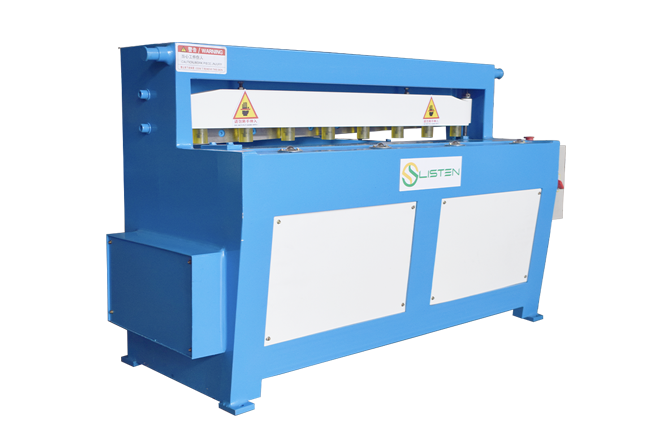
Small Electric and Utility Shearing Machine Options
Smart Internal Linking Note for Fabricators:
To understand the baseline mechanical differences between classic mechanical drives and high-pressure oil systems, check out our comparison report: Mechanical Shearing Machine vs Hydraulic Shearing Machine: A Deep Comparison of Functionality and Applicability.
To learn how to program automated precision backgauges on your new cutting line, review our control manual: Delem Touch Control Systems for Hydraulic Shearing Machines.
A: Material deformation during shearing occurs due to the structural twisting force exerted as the upper blade pushes through the sheet. "Bow" causes the ends of the strip to curve upward, while "twist" causes the strip to rotate along its longitudinal axis. This issue is most severe when cutting narrow strips. It can be minimized by utilizing a hydraulic guillotine shear and dialing the programmable rake angle down to its lowest possible setting.
A: Swing beam shears require a slightly curved or specifically radiused upper blade to maintain an even cutting clearance across the circular arc stroke. Because of this curve, the upper blade can only have 2 cutting edges. In contrast, a guillotine shear moves strictly vertically, allowing the use of straight, 4-edged rectangular blades for both the upper and lower positions. This means you can rotate the blades four times before needing a professional regrind, effectively doubling tooling longevity.
A: Yes, provided the machine is engineered with sufficient hydraulic tonnage and fitted with high-carbon, high-chrome blades specifically rated for stainless steel. However, because stainless steel work-hardens rapidly and demands high cutting precision to prevent burrs, a guillotine shear with a programmable CNC automatic blade gap system is generally preferred for dedicated stainless processing facilities.
A: When cutting a thick steel plate, a low rake angle spreads the cutting load across a wide surface area, requiring massive hydraulic force that could overload the system. By increasing the rake angle (tilting the blade higher), the blade cuts through less material at any single micro-second of the stroke. This allows a machine with standard hydraulic cylinders to safely slice through heavy plates without straining its hydraulic pump or valves.
Choosing between swing beam and guillotine mechanical frameworks requires evaluating your day-to-day material thicknesses, part geometric complexity, and production budget. At Listen CNC, we manufacture robust, precision-engineered metal cutting and forming lines outfitted with elite international control systems (like Delem, Estun, and Cybelec) to optimize your workshop's daily throughput.
Ready for a direct factory consultation or a customized cutting quote? Connect with our hydraulic engineering team today to request structural blueprints, backgauge configurations, or a comprehensive machinery assessment.