Press brake tonnage is the bending force required to form a specific material over a given bend length. Selecting the correct tonnage matters because an undersized machine may not complete the bend, while excessive force can overload tooling, damage the workpiece or place unnecessary stress on the press brake.
This press brake tonnage calculator and chart explains how material thickness, tensile strength, bend length and V-die opening affect required bending force. The calculations below are intended primarily for air bending. Always verify the final setup against the tooling rating, machine manual and actual material specification before production.
Press brake tonnage increases when material thickness, tensile strength or bend length increases.
Increasing the V-die opening generally reduces the required bending force, although the resulting bend radius, minimum flange and part geometry must also remain acceptable.
A commonly used metric air-bending formula relates bending force to bend length, material tensile strength, sheet thickness and V-die opening:
| Symbol | Meaning | Unit |
|---|---|---|
| F | Required bending force | kN |
| L | Total bend length | mm |
| σm | Material tensile strength | N/mm² (MPa) |
| S | Sheet thickness | mm |
| V | V-die opening | mm |
This calculation method is consistent with the air-bending reference published in LVD Tooling Essentials. Actual required force may vary with tooling geometry, bend angle, material condition and machine configuration.
The V-die opening is one of the most important variables in bending-force calculation. For conventional air bending of mild steel, a frequently used starting point is:
A wider V-opening reduces force because the sheet is supported farther away from the bend line. A narrower V-opening increases required tonnage and generally produces a smaller inside bend radius.
The 8× rule is a starting reference, not a universal specification. High-strength steels, short flange dimensions, specified bend radii and special tooling can require a different opening. Bystronic discusses both the common 8× V-die rule and its practical limitations. You can also review LISTEN's press brake die selection guide for tooling considerations.
The following chart is a calculated reference for 1 meter of air-bending length, using:
Mild-steel reference tensile strength: 450 N/mm²
V-opening: 8 × sheet thickness
Air bending
Force shown in both kN/m and metric ton-force per meter
| Thickness | Reference V Opening | Force per Meter | Approx. Metric Tons / Meter |
|---|---|---|---|
| 1.0 mm | 8 mm | 79.9 kN/m | 8.1 t/m |
| 1.5 mm | 12 mm | 119.8 kN/m | 12.2 t/m |
| 2.0 mm | 16 mm | 159.8 kN/m | 16.3 t/m |
| 2.5 mm | 20 mm | 199.7 kN/m | 20.4 t/m |
| 3.0 mm | 24 mm | 239.6 kN/m | 24.4 t/m |
| 4.0 mm | 32 mm | 319.5 kN/m | 32.6 t/m |
| 5.0 mm | 40 mm | 399.4 kN/m | 40.7 t/m |
| 6.0 mm | 48 mm | 479.3 kN/m | 48.9 t/m |
| 8.0 mm | 64 mm | 639.0 kN/m | 65.2 t/m |
| 10.0 mm | 80 mm | 798.8 kN/m | 81.4 t/m |
| 12.0 mm | 96 mm | 958.5 kN/m | 97.7 t/m |
Assume:
Thickness S = 3 mm
Bend length L = 1000 mm
Tensile strength σm = 450 N/mm²
V-opening V = 24 mm
F = (1.42 × 1000 × 450 × 3²) / (1000 × 24)
F ≈ 239.6 kN ≈ 24.4 metric tons
If the same material is bent over a 2-meter length, the theoretical force approximately doubles to 48.9 metric tons. This is why bend length must always be included when sizing a press brake.
Thickness alone does not determine tonnage. If two 3 mm sheets use the same 24 mm V-die but one material has significantly higher tensile strength, the stronger material requires more force.
3 mm × 1000 mm bend × 24 mm V-opening requires approximately 239.6 kN.
Under the same geometry, the calculated force rises to approximately 372.8 kN.
The 700 MPa figure above is an illustration, not a universal value for stainless steel or any other material. Use the tensile-strength value from the actual material specification or mill certificate whenever available.
Thickness appears squared in the formula. Even a modest increase in sheet thickness can therefore produce a large increase in required force.
Required force increases approximately in proportion to bend length. A 2-meter bend requires about twice the force of the same 1-meter bend under otherwise identical conditions.
Stronger materials require higher bending force. Do not assume that equal thickness means equal tonnage across mild steel, stainless steel, aluminum or high-strength steel.
A wider V-opening reduces calculated bending force, while a narrower opening increases it. However, V-opening also influences bend radius and flange requirements.
The calculated bending force should not automatically become the machine's nominal capacity. Machine selection must also consider working length, tooling capacity, off-center loading limits, part geometry, bending method and a practical engineering margin.
For example, a theoretical requirement of approximately 49 tons for a 2-meter bend does not necessarily mean that a 50-ton machine is the ideal choice. Operating continuously at or near maximum rated capacity leaves very little allowance for material variation or changes in tooling.
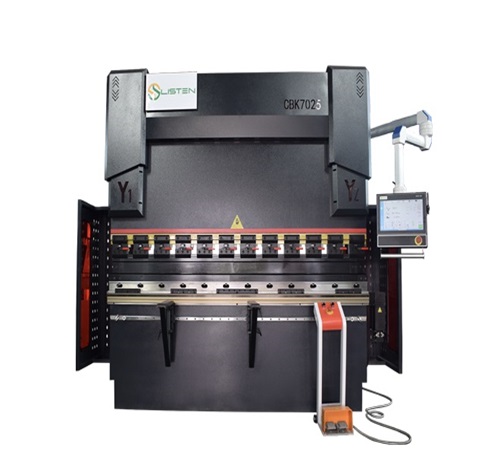
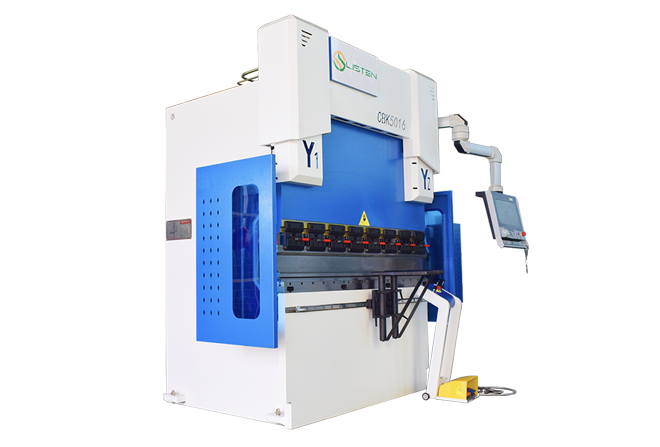
As an example, LISTEN's current 3–4 Axis Press Brake range includes configurations such as 50T/1600, 80T/2500, 110T/2500, 110T/3200 and higher capacities.
The correct model should therefore be selected only after comparing the calculated force with the required working length and tooling load. For larger or more complex bending applications, higher-axis configurations may also be considered based on backgauge and part-positioning requirements.
The tonnage chart on this page is intended for air-bending calculations. Air bending forms the sheet without forcing the entire material surface into the bottom of the V-die.
Bottoming and coining use different contact conditions and can require substantially different force. Do not apply an air-bending chart directly to these operations.
For non-standard forming, thick plate, high-strength material or special tooling, confirm the required tonnage with the tooling supplier and the machine manufacturer before running production parts.
Excessive bending force can damage tooling and machine components and may create additional risk at the point of operation. Operators should never exceed the rated capacity of the press brake or tooling.
Machine safeguarding is equally important. See LISTEN's press brake safety arrangements and the OSHA powered press brake guidance for additional safety information.
Press brake tonnage describes the force available or required during bending. Machine capacity is usually expressed in tons or kilonewtons, while bending charts may show force per meter or per foot.
For metric air bending, one common calculation is F = (1.42 × L × σm × S²) / (1000 × V), where bend length, tensile strength, thickness and V-die opening are entered into the formula.
Not necessarily. Thickness is squared in the bending-force formula, although V-die opening often changes with thickness as well. Always recalculate rather than using a simple linear estimate.
A wider die supports the sheet farther from the bend line, increasing mechanical leverage and reducing the force needed to form the bend. The wider opening also changes the resulting bend radius and minimum flange requirement.
No. It is a useful starting point for many conventional mild-steel air-bending applications, but high-strength steel, stainless steel, aluminum, short flanges and specified bend radii may require different tooling.
There is no single margin that is correct for every application. Final machine selection should account for actual material variation, tooling capacity, working length, off-center loading and the machine manufacturer's operating recommendations.
It can. Required force depends on the actual tensile strength of the grade being bent. Use the material specification rather than applying one universal stainless-steel multiplier.
No. The chart is intended as an air-bending reference. Bottoming and coining involve different forming conditions and should be calculated or verified separately.
Provide material grade, tensile strength if known, maximum thickness, maximum bend length, required bend angle and radius, flange dimensions, V-die opening and typical production requirements.
Send LISTEN your material grade, thickness, maximum bend length, bend drawing and expected production volume. The technical team can compare the calculated tonnage with working length, tooling and machine configuration before recommending a suitable solution.
VIEW PRESS BRAKE OPTIONS → SEND YOUR BENDING REQUIREMENTS